
How to Choose the Right Fiber Laser Cutting Machine for Your Business
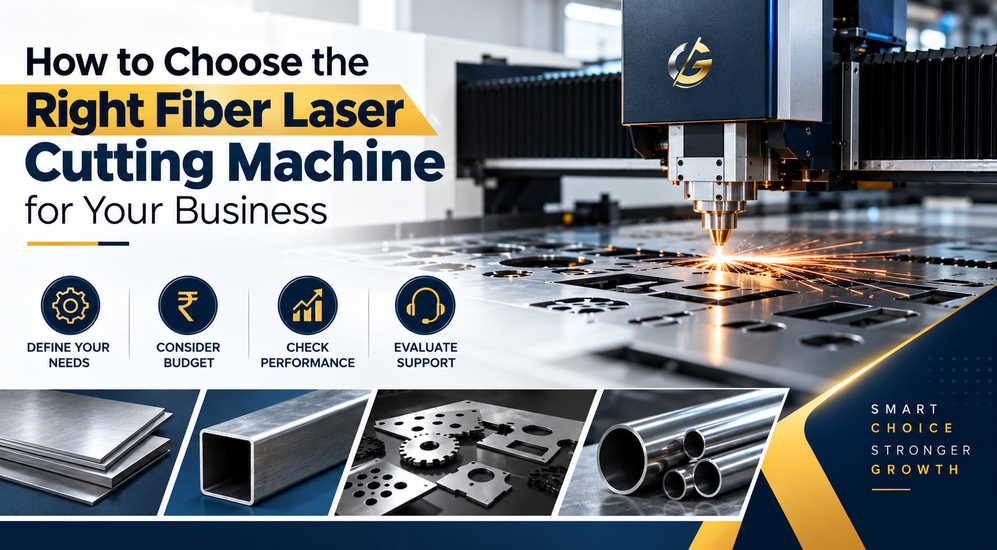
Choosing a fiber laser cutting machine is an important decision for any manufacturing or fabrication business. The right machine can support your production requirements, while the wrong configuration may leave you with capacity you do not need or limitations that affect your workflow.
Laser power is often the first specification manufacturers look at. However, power alone does not determine whether a machine is suitable for your business.
Material type, thickness, working requirements, production volume, machine configuration, component quality and after-sales support also need to be considered.
So, how do you choose the right laser cutting machine?
The answer starts with understanding your actual production requirements.
1. Start With the Material You Process
The first question to ask is simple:
What materials will the machine cut regularly?
Different manufacturing businesses work with different metals and thickness ranges. Your regular material requirements should therefore influence the machine configuration you choose.
For example, a fabrication unit may have different requirements from an automotive component manufacturer or a company producing structural components.
Before selecting a machine, prepare a list of:
Materials you currently process
Materials you may process in the future
Common material thicknesses
Maximum material thickness
Typical component sizes
Expected production volume
This gives you a practical starting point instead of selecting a machine based only on its advertised specifications.
2. Consider the Required Laser Power
Laser power is one of the most visible specifications when comparing a fiber laser cutting machine.
However, choosing the highest available power is not automatically the right decision.
Your required power depends on factors such as:
Material type
Material thickness
Required cutting speed
Production volume
Cutting quality requirements
Type of applications
A manufacturer processing thinner materials for general fabrication may have different requirements from a company regularly working with heavier sections.
Therefore, laser power should be selected according to your actual production requirements.
3. Look at Your Production Volume
Production volume can change the type of machine configuration that makes sense for your business.
If laser cutting is only one part of your production process, your requirements may be different from a manufacturing unit where laser cutting runs continuously throughout the day.
For higher production requirements, manufacturers may need to consider:
Cutting speed
Material handling
Loading and unloading
Machine stability
Production cycle time
Automation requirements
Overall machine utilization
In other words, do not look at cutting speed in isolation. The complete production cycle matters.
4. Decide Between Sheet, Pipe or Combination Cutting
Another important decision is the type of material you want to process.
Some businesses primarily work with flat sheets. Others regularly process pipes and tubes. Some require both.
A fiber laser cutting machine can be configured according to the application.
Sheet Metal Cutting
If your business mainly processes flat sheets, a dedicated sheet metal laser cutting system may be appropriate.
These machines are commonly considered for applications involving:
Sheet metal fabrication
Engineering components
Industrial equipment
Automotive components
General metal fabrication
Pipe and Tube Cutting
If your production involves pipes, tubes or structural profiles, you should evaluate machines specifically designed for these applications.
Dedicated pipe cutting systems can be developed around requirements such as:
Pipe diameter
Processing length
Chuck configuration
Profile shape
Loading and unloading
Production volume
Sheet + Pipe Combo
Some manufacturers need both sheet and pipe cutting capabilities.
In such cases, a Sheet + Pipe Combo Machine can provide flexibility from a single platform.
However, if tube processing forms a major part of your production, it is worth comparing a combination system with a dedicated pipe cutting machine.
The better configuration depends on your actual production workflow.
5. Check the Required Working Area
For sheet cutting applications, working area is another important consideration.
Before choosing a machine, understand the sheet sizes you commonly process.
Think about:
Standard sheet dimensions
Maximum sheet size
Material loading requirements
Available factory space
Future production requirements
Choosing a working area that matches your regular production can help avoid unnecessary limitations later.
6. Consider Pipe Size and Processing Length
For businesses considering a pipe cutting system, pipe dimensions become particularly important.
A machine designed for smaller tubes may not be suitable for applications involving longer or larger profiles.
The supplied Genesys Lasers machine information includes different configurations developed for different pipe processing requirements.
For example, the company has highlighted a 6kW Fiber Laser Pipe Cutting Machine with a 220 mm pneumatic chuck and 7.5-meter pipe processing capacity. Another 3kW configuration features a 240 mm chuck and 6.5-meter pipe processing capacity, while a 120 mm chuck configuration is designed for smaller-diameter tubes with a 6-meter processing length.
These examples show why manufacturers should match the machine configuration to the actual dimensions of the workpieces they process.
7. Check the Types of Profiles You Need to Cut
Pipe cutting does not always mean round pipes.
Many industrial applications involve different structural profiles.
Depending on the machine configuration, applications can include:
Round pipes
Square pipes
Rectangular tubes
I-beams
L-angles
If your business works with multiple profiles, make sure the machine configuration supports your production requirements.
This is particularly important for companies involved in structural fabrication, construction equipment, agricultural machinery and heavy engineering.
8. Think About Loading and Unloading
Cutting is only one part of the production process.
Material handling can also affect overall productivity.
For pipe cutting, the loading and unloading process becomes especially important when working with longer or heavier workpieces.
A machine designed around your production workflow can help make material handling more practical.
Before making a decision, consider:
How material will enter the machine
How finished components will be removed
Whether manual handling is practical
Production frequency
Workpiece length and weight
Available floor space
These factors can make a noticeable difference in day-to-day operation.
9. Machine Stability and Accuracy Matter
A laser machine is expected to deliver consistent results throughout production.
Therefore, machine construction and stability deserve attention alongside laser power.
For precision applications, manufacturers should consider:
Machine rigidity
Motion system
Positioning
Cutting head
Control system
Mechanical design
Overall machine configuration
Consistent machine performance becomes particularly important when production involves repeated components or tight dimensional requirements.
10. Consider the Components Used in the Machine
The quality of the machine is not determined by its outer appearance.
Internal components and systems also contribute to machine performance.
When evaluating a machine, ask about the important components used in:
Laser source
Cutting head
Motion system
Drive system
Control system
Cooling system
Electrical system
Understanding these components can help you compare machines beyond their basic power rating.
11. Think About Future Production Requirements
A machine should not only match today’s requirements.
Manufacturers should also consider how their production may change over the next few years.
For example, you may currently process a limited range of materials but plan to expand into larger components or new applications.
Therefore, consider:
Future material requirements
Expected production growth
New product categories
Additional profile sizes
Increased production volume
Automation possibilities
A machine that fits your current production but creates major limitations later may not be the right long-term solution.
12. Service and Technical Support Are Important
Buying a laser machine is not the end of the process.
Like any industrial equipment, the machine requires proper operation, maintenance and technical support.
Before choosing a manufacturer, understand what kind of support is available for:
Installation
Machine commissioning
Maintenance
Troubleshooting
Spare parts
Technical support
Operator guidance
Good technical support becomes particularly important when a machine is a critical part of your production process.
Unexpected machine downtime can affect production schedules, so service support should be considered during the machine selection stage rather than after installation.
13. Why Application-Specific Machine Design Matters
Not every manufacturing company needs the same laser machine.
A company producing sheet metal components may require a different configuration from a company processing long pipes or structural profiles.
This is where application-specific machine design becomes useful.
Genesys Lasers has highlighted its approach of developing customized Fiber Laser Pipe Cutting Machines around specific production requirements and applications. Its supplied machine information includes dedicated systems for different pipe sizes, processing lengths and profile requirements.
This approach allows the machine configuration to be considered alongside the actual manufacturing process instead of treating every customer requirement as identical.
14. How Genesys Lasers Approaches Fiber Laser Machine Manufacturing
Genesys Lasers develops laser cutting solutions with a focus on precision engineering, in-house manufacturing and application-specific machine development.
Its manufacturing approach includes in-house machine body production, quality-focused components and R&D activities. The company has also showcased dedicated Fiber Laser Pipe Cutting Machines developed for tubular and profile processing.
For manufacturers evaluating a new laser cutting system, understanding the manufacturer’s engineering and production capabilities can be just as important as comparing machine specifications.
A Simple Checklist Before Buying a Fiber Laser Cutting Machine
Before finalizing a machine, ask yourself these questions:
Material
What materials will I process?
What thickness range do I need?
Production
How many hours will the machine operate?
What production volume do I expect?
Machine
What laser power do I actually need?
What working area is suitable?
Pipe/Profile
Do I need sheet cutting, pipe cutting or both?
What pipe diameters and lengths do I require?
Which profiles do I need to process?
Support
What installation and technical support is available?
How will maintenance and spare parts be handled?
Future
Can the machine support my expected production growth?
Answering these questions before contacting a machine manufacturer can make the selection process much clearer.
Conclusion
Choosing the right fiber laser cutting machine requires more than comparing laser power and price.
Material type, thickness, production volume, working area, pipe dimensions, profile requirements, machine stability, component quality and technical support all play a role in the final decision.
For manufacturers working with pipes and structural profiles, dedicated pipe cutting systems may provide a more application-focused solution. On the other hand, businesses requiring both sheet and pipe processing may need to evaluate a combination machine.
The right choice ultimately depends on your production requirements.
Before investing in a new laser cutting system, clearly define your current workload and future requirements. Then discuss those requirements with a machine manufacturer that can recommend a suitable configuration.
If you are evaluating a fiber laser cutting machine for sheet, pipe or profile processing, Genesys Lasers can help you discuss your application requirements and identify a suitable machine configuration.
Frequently Asked Questions
What should I consider before buying a fiber laser cutting machine?
Consider material type, thickness, laser power, working area, production volume, machine configuration, components, maintenance requirements and technical support.
Is higher laser power always better?
Not necessarily. The required laser power depends on the material, thickness, cutting requirements and production volume. Selecting power according to the actual application is more practical than simply choosing the highest rating.
Should I choose a sheet laser or pipe cutting machine?
The choice depends on what you manufacture. Businesses mainly processing flat sheets may need a sheet cutting system, while businesses focused on tubes and profiles may benefit from a dedicated pipe cutting configuration.
What profiles can a pipe laser cutting machine process?
Depending on the machine configuration, applications can include round pipes, square pipes, rectangular tubes, I-beams and L-angles.
Why is technical support important when buying a laser machine?
Laser machines are complex industrial systems. Installation, maintenance, troubleshooting and technical support can become important throughout the machine’s operating life.
Can a laser machine be customized for specific production requirements?
Machine configuration can be developed around factors such as material, workpiece dimensions, production volume and application requirements. The available customization depends on the manufacturer and machine design.