
Fiber Laser vs CO2 Laser Cutting Machine: What’s the Difference?
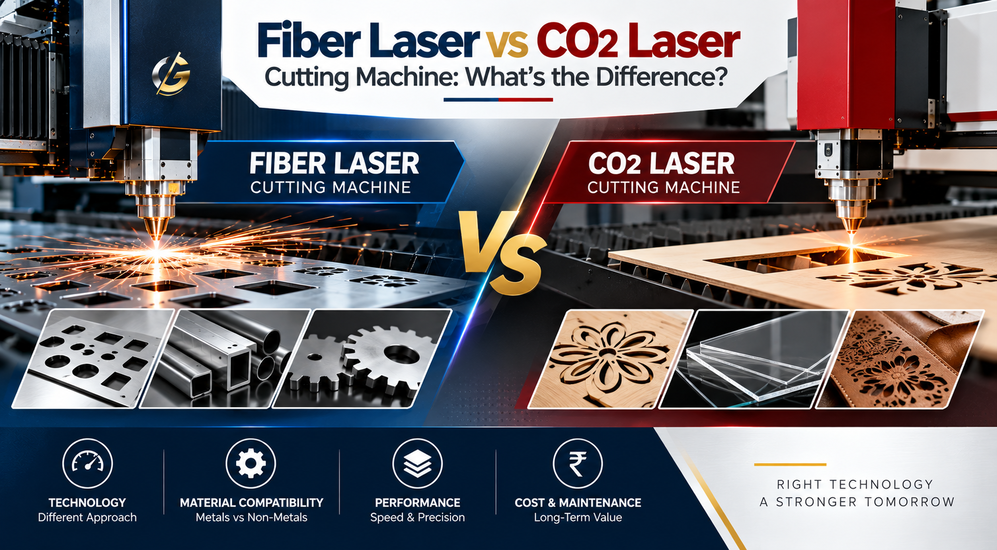
Fiber Laser vs CO2 Laser: Understanding the Difference
When choosing a laser cutting machine, manufacturers often compare fiber laser vs CO2 laser technology. Both systems use a focused laser beam to cut materials, but they generate and deliver the laser beam differently.
The right choice depends on factors such as material, thickness, production volume, machine requirements and the type of components being manufactured.
Understanding these differences can help manufacturers evaluate which technology fits their production process.
What Is a Fiber Laser Cutting Machine?
A fiber laser cutting machine generates the laser beam using a fiber-based laser source. The beam travels through an optical fiber and is focused onto the workpiece through the cutting head.
Fiber laser technology is widely used for industrial metal cutting applications because it can provide precise and efficient processing.
Common applications include:
- Sheet metal cutting
- Metal component manufacturing
- Automotive components
- Structural fabrication
- Industrial machinery
- General metal fabrication
Fiber laser systems are particularly common in modern metal-processing applications.
What Is a CO2 Laser Cutting Machine?
A CO2 laser cutting machine uses a gas mixture as the laser medium. The generated laser beam travels through an optical path before reaching the cutting head.
CO2 laser systems have been used for many years in industrial cutting and fabrication applications.
Depending on the machine configuration, they can be used for processing different materials and applications.
Fiber Laser vs CO2 Laser: How Do They Differ?
The main differences come from the laser source, beam delivery system, machine configuration and operating requirements.
Let’s compare the key factors.
1. Laser Source
A fiber laser uses a solid-state laser source with optical fiber for beam delivery.
A CO2 laser uses a gas-based laser source and requires an optical path to deliver the beam.
This difference affects the overall machine design and maintenance requirements.
2. Cutting Speed
Fiber laser machines can provide high cutting speeds, particularly when processing thinner metal sheets.
The actual cutting speed depends on several factors, including:
- Laser power
- Material type
- Material thickness
- Cutting parameters
- Part geometry
- Assist gas
Therefore, manufacturers should evaluate cutting performance based on their actual production requirements rather than laser power alone.
3. Metal Cutting Applications
Fiber laser technology is widely used for metal-processing applications involving materials such as mild steel and stainless steel.
It can be applied to different manufacturing requirements, including sheet metal, components and structural parts.
CO2 laser machines can also be used for industrial cutting, but the suitability of each technology depends on the specific material and production application.
4. Energy and Operating Requirements
The laser source and beam delivery system influence the machine’s overall energy and operating requirements.
Fiber laser systems generally have a more compact optical path because the beam travels through optical fiber rather than a traditional mirror-based beam path.
However, total machine operating cost depends on more than the laser source. Manufacturers should also consider electricity, consumables, maintenance, assist gases and production volume.
5. Maintenance
Maintenance requirements are another important consideration when comparing fiber laser vs CO2 laser systems.
Fiber laser machines have fewer components in the beam delivery path, which can simplify certain maintenance tasks.
CO2 laser machines have additional optical components that require proper inspection, cleaning and alignment.
Regular maintenance remains important for both technologies to maintain cutting quality and machine performance.
Fiber Laser vs CO2 Laser for Sheet Metal Cutting
For manufacturers primarily processing metal sheets, fiber laser technology is an important option to consider.
A fiber laser cutting machine can be configured according to:
- Sheet size
- Material type
- Material thickness
- Required laser power
- Production volume
- Automation requirements
For example, manufacturers handling thin and medium-thickness metal sheets may have different requirements from manufacturers processing thicker materials or large production volumes.
Therefore, machine selection should start with the production application.
Fiber Laser vs CO2 Laser: Which Materials Can They Process?
Material compatibility depends on the machine configuration, laser power and processing parameters.
Fiber laser machines are commonly used for:
- Mild steel
- Stainless steel
- Other suitable metals
CO2 laser systems can also process various materials, depending on their configuration and intended application.
For industrial metal cutting, manufacturers should check the machine’s specified material range before making a purchase decision.
Which Technology Is Better for Your Production?
There is no single choice that fits every manufacturing operation.
A manufacturer should first understand its production requirements.
Consider these questions:
What material do you cut?
Identify the materials processed regularly.
What thickness do you cut?
Look at both your regular and maximum thickness requirements.
How much do you produce?
Production volume can influence the required machine configuration.
What component sizes do you process?
Sheet dimensions and workpiece size are important when selecting the working area.
What level of automation do you need?
High-volume production may require additional loading, unloading or automation systems.
What are your maintenance requirements?
Consider routine maintenance, consumables and technical support.
Fiber Laser vs CO2 Laser: Quick Comparison
| Factor | Fiber Laser | CO2 Laser |
|---|---|---|
| Laser source | Solid-state fiber source | Gas-based source |
| Beam delivery | Optical fiber | Optical path |
| Metal cutting | Widely used | Used in various applications |
| Thin metal processing | High-speed applications | Suitable depending on configuration |
| Machine design | Compact optical path | More optical components |
| Maintenance | Generally simpler beam path | More optical components |
| Application | Modern metal manufacturing | Various industrial applications |
Actual performance varies with machine configuration, laser power, material, thickness and cutting parameters.
Why Application Should Come Before Machine Selection
When comparing fiber laser vs CO2 laser, it is easy to focus only on specifications.
However, the machine should ultimately match the production requirement.
For example, a manufacturer processing automotive components may have different requirements from a structural fabrication company. Similarly, a company cutting long pipes and profiles may need a dedicated pipe cutting solution instead of a conventional sheet cutting machine.
This is why material, workpiece dimensions, production volume and application should be evaluated before selecting the technology.
Fiber Laser Technology for Industrial Manufacturing
Fiber laser cutting machines are now used across several industrial sectors, including automotive manufacturing, structural fabrication, construction equipment, furniture production, agricultural machinery and heavy engineering.
The machine configuration can vary depending on the application.
For pipe and profile processing, dedicated fiber laser pipe cutting machines can be designed to handle profiles such as round pipes, square pipes, rectangular tubes, I-beams and L-angles.
How Genesys Lasers Approaches Laser Cutting Solutions
Genesys Lasers develops laser cutting solutions around industrial production requirements and specific applications.
The company’s machine range includes fiber laser solutions for different metal-processing requirements, including dedicated pipe and profile cutting applications.
For manufacturers evaluating a laser cutting machine, the important step is to match the machine configuration with the material, component size and production requirements.
Conclusion
The comparison between fiber laser vs CO2 laser involves more than simply looking at laser power.
Laser source, beam delivery, material, thickness, cutting requirements, maintenance and production volume all influence the suitability of a machine.
For modern metal manufacturisng applications, fiber laser technology provides an important option for manufacturers looking for an industrial laser cutting solution. However, the final machine selection should always be based on the specific production application.
Frequently Asked Questions
Is fiber laser better than CO2 laser for metal cutting?
Fiber laser technology is widely used for industrial metal cutting. However, suitability depends on material, thickness, production requirements and machine configuration.
What is the main difference between fiber laser and CO2 laser?
The main difference is the laser source and beam delivery system. Fiber lasers use a solid-state fiber-based source, while CO2 lasers use a gas-based laser source.
Which laser is suitable for sheet metal cutting?
Fiber laser machines are widely used for sheet metal cutting, particularly in modern industrial metal-processing applications. The appropriate machine depends on material, thickness and production requirements.
Does a fiber laser require maintenance?
Yes. Fiber laser machines still require regular maintenance, including inspection of the cutting head, nozzle, protective lens, cooling system and other machine components.
Can fiber lasers cut pipes and profiles?
Yes. Dedicated fiber laser pipe cutting machines can be configured for tubular and structural profiles such as round pipes, square tubes, rectangular tubes, I-beams and L-angles.